
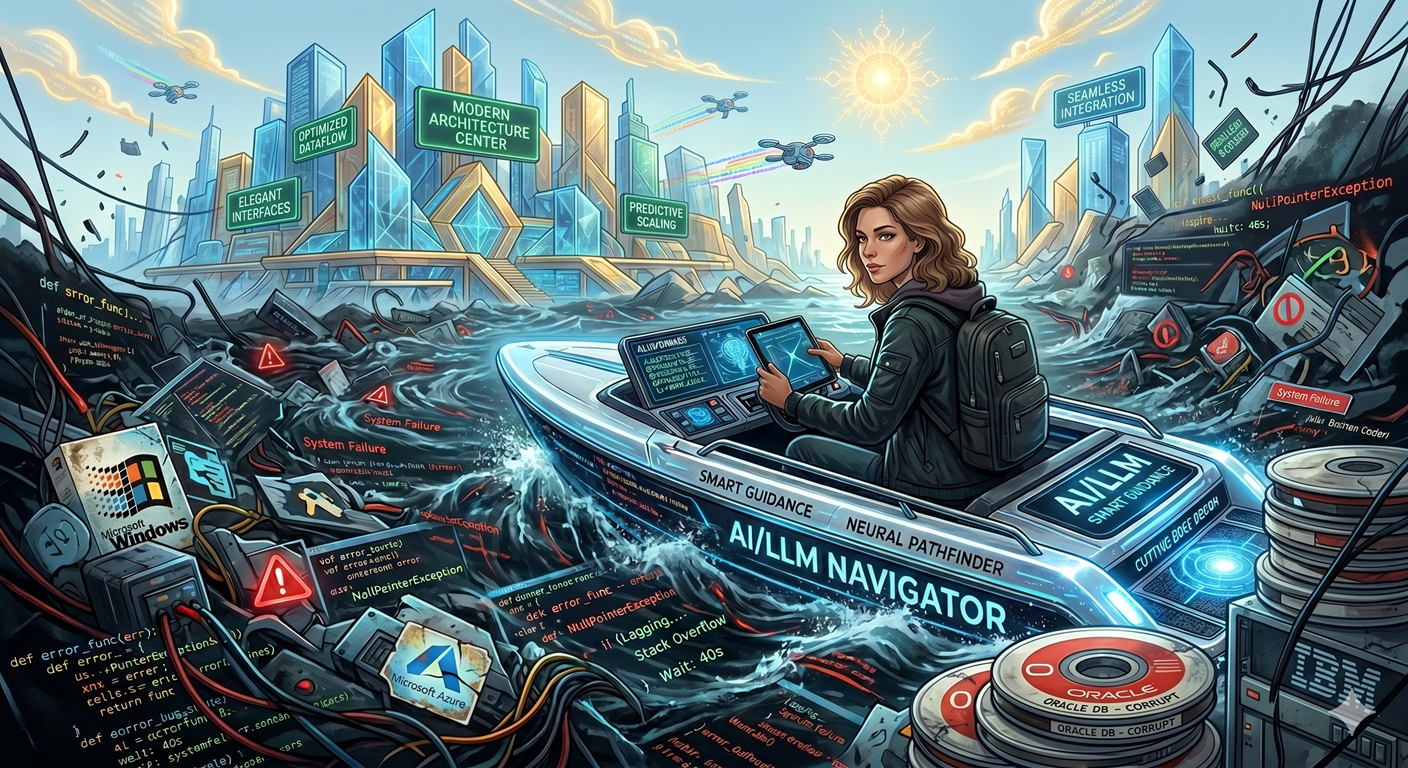
We are at the precipice of the greatest shift of economic and productive power in the history of technology. Right now, AI is enriching a lot of old big companies (Microsoft, Meta, Nvidia) and some new big companies (Anthropic, OpenAI). As the technology matures, though, it is going to siphon vast amounts of power away from large incumbents to nimble creators, creating a level of competition not seen since the earliest days of computing.
Historically, software was so challenging to develop that building the major pillars of computing—operating systems, productivity software, databases, publishing platforms, etc.—required massive amounts of capital and resources. As long as these products were “good enough,” there was no realistic way to assemble the necessary capital and talent to rebuild better versions of them. Only a handful of companies possessed the required expertise to create and maintain software at massive scale under the old development paradigm.
This “complexity moat” isolated these businesses from traditional market pressures, creating stagnating products and a proliferation of antifeatures. As just one example, consider operating systems. There are three desktop OSes (Windows, MacOS, and various Linux flavors) and two mobile OSes (Android and iOS). All are effectively impossible for normal people to modify, either due to complexity (Android and Linux) or being closed-source (the rest).
The consequences are as predictable as they are unfortunate. Windows is a bloated advertising platform that even Microsoft admits sucks, iOS functions more as a tollbooth than a feature-complete OS, and most SaaS products have disregarded usability since about 1997. Users have nowhere to go: you can’t improve your house, and you can’t leave it.
This state of affairs has dramatically constrained the pace of software development. Developers need to live within hostile environments, use poorly-maintained APIs, and in the case of mobile operating systems, pay extortionate fees just to distribute their products to willing customers.
That is changing quickly. Making software much easier to write and modify means that, for the first time, people outside of major tech companies have a say in the products they use, and simply producing complex software will no longer provide a defensible moat.
Understanding how this shift happens helps us predict where the next generation of great software companies will come from and undergirds our entire investment thesis. The power and money that drains away from incumbents will not just evaporate but rather flow toward those who are building for a fundamentally different model of how people use technology.
This shift will be the biggest advancement in computing since the PC, and I expect it to occur in three stages.
Stage I – the custom abstraction layer
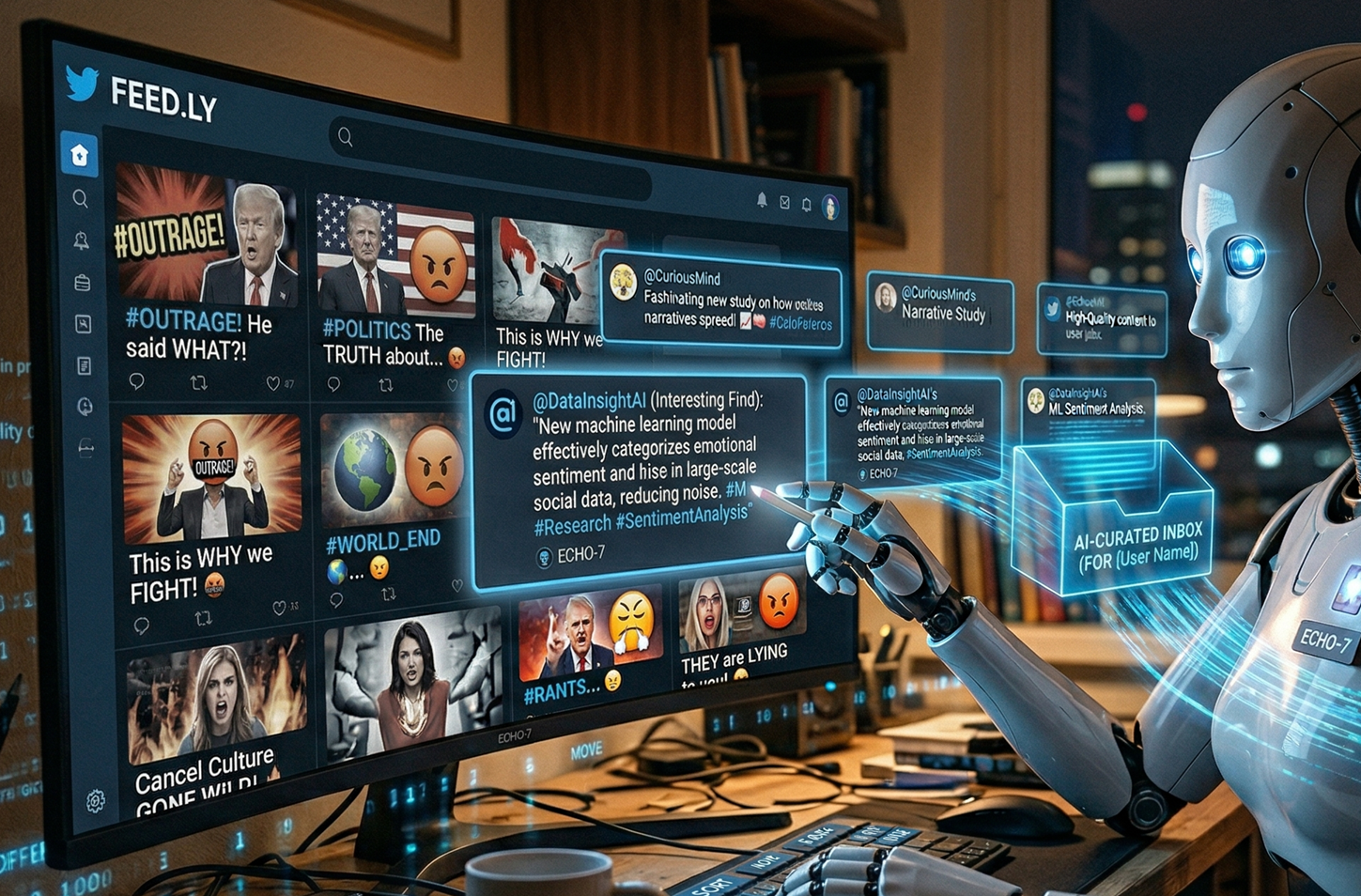
Just the interesting stuff, please.
Probably the worst products in computing history are social media platforms. Designed to farm attention, they manipulate, outrage, and advertise. Currently, the only winning move is not to play.
What if you could excise out the bad parts of social media and just keep the connections and content you want to see? Well, you can! I recently started using Twitter again, but it is not really Twitter; it’s a highly abstracted version of Twitter provided to me by my OpenClaw agent. I tell it what accounts I care about and generally describe the kind of content I want to see, it surfaces interesting tweets to me, and I tell it how I want to respond. I am in total control of the entire experience.
This automated curation and interaction is the future of software engagement, especially with overtly hostile products like social media. Right now, Twitter is one of the few social media platforms that offers an API, but as agents get better, cheaper, and faster, that won’t matter.[1]
It is not just social media, either. Consider the tragedy of Google Search. It used to be an amazing product, but as soon as Google realized they had a durable complexity moat, they destroyed it. Thanks to AI, though, Google search traffic is down for the first time in history, because consumers have an escape hatch. Tools like Kagi can scrape the index, disregard the junk, and return what the user actually wanted. We’re still benefiting from the index but can avoid the junk content and anti-user UI.
Having agents build a custom abstraction layer on top of lousy products is going to become just how we interact with computers. Whether in search, government websites, Salesforce databases, or anything else, we will all soon be asking our computers to do the electronic equivalent of waiting in line for us.
This first phase is the event horizon for these old incumbents. They’re not being crushed to death quite yet, but they’re never going to escape death. Users have already left them behind. Their dashboards are all green and revenue is stable, but the dependence is broken. They are responding by frantically jamming “AI” into everything, but doing so isn’t solving the underlying problem, which is that they no longer have the captive audience upon which their business models are premised.
Stage II – just build your own software or modify open-source stuff
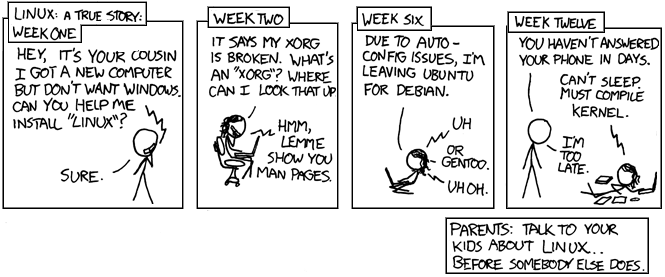
“Recompiling my kernel” will go from a joke to just a normal thing that we ask our AIs to do for us when we want to change something.
It’s already starting to happen with SaaS, but it won’t stop there. If you want an operating system that isn’t awful, maybe you try Linux, but because it doesn’t do some subset of things for which you needed Windows or feels hard to use, you give up. Today, that’s a showstopper, but as agents improve, you can just ask them to fix or modify things.
Already, heavy users of AI tools are having them build small programs to automate basic tasks. Even if you haven’t specifically requested one, it’s very likely that an LLM has, on its own, created at least a simple script to help it solve a problem you posed.
The combination of these models with open source is incredibly powerful: the combined knowledge of every contributor mixes with a universal developer. Almost anyone who knows even basic programming has at least a few open-source projects that they’ve modified the hell out of.[2] With sophisticated AI tools, though, this hobbyist-style activity can go mainstream. Hate Excel? Have your agent modify an open-source spreadsheet alternative to do exactly what you want it to do and keep tweaking it forever. If you make some major improvements, throw it up on GitHub for everyone else. If it’s really excellent, you can turn it into a business, offer support, and sell it. OpenClaw itself was developed in this manner.
It is not just open source, either. For difficult tasks, it will always make sense to purchase complex software, but the cost of developing that software will be greatly reduced and thus much more competitive. Instead of being limited to the products produced by a handful of oligopolists, agents and their masters will scour the internet for the best tools. There will still be lots of money in software development, because while there’s infinite demand for great software, time (and tokens) are limited. Build vs. buy will become the decision framework for every possible tool, business, and consumer.
Stage III – These Are the Voyages. . . .
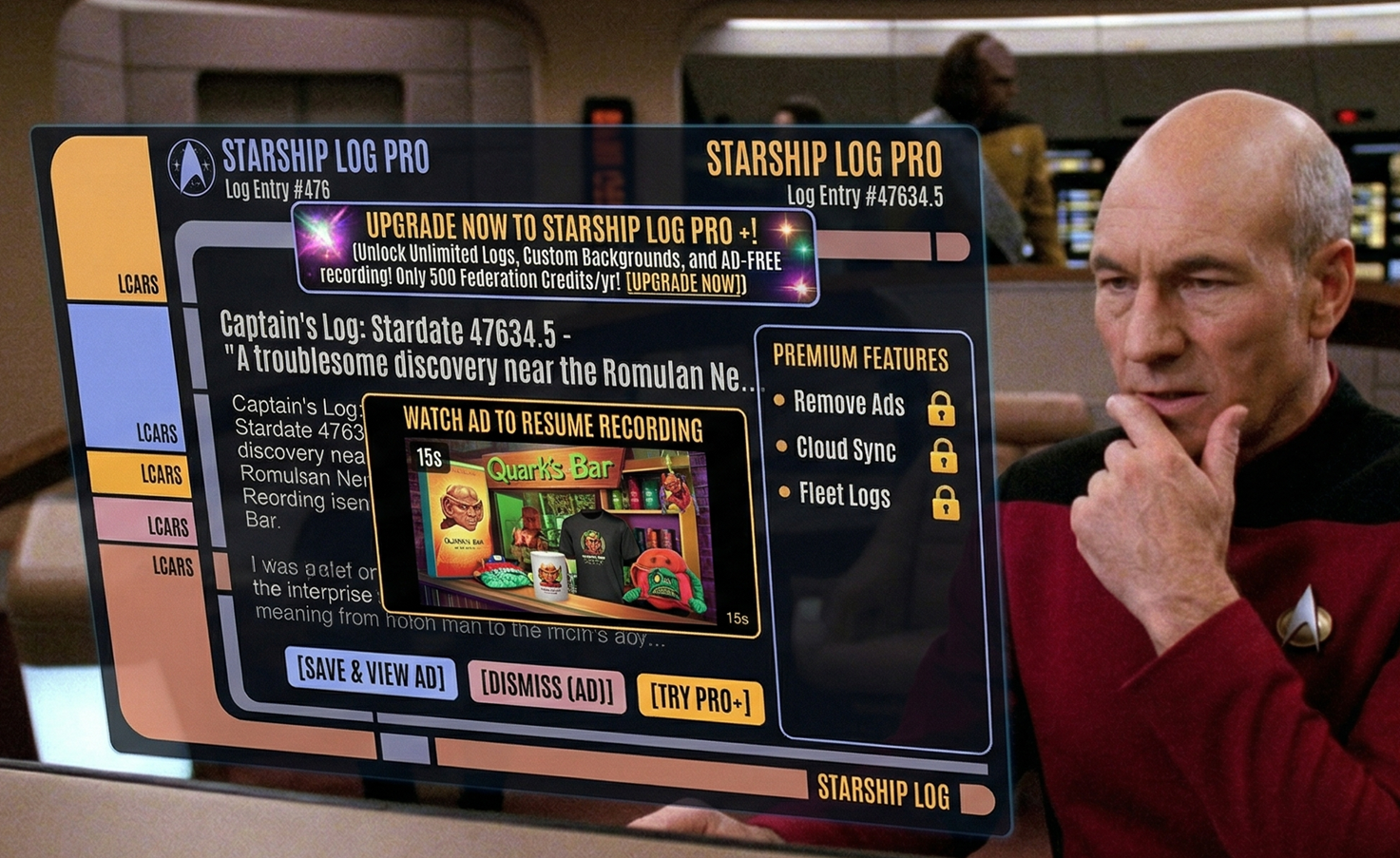
Not what Gene had in mind—and definitely not the future
In the more distant future, we probably won’t interact with “apps” at all. They’ll exist, but only as tools for agents to use.
I’ve seen glimmers of this future, although it is still very early. I sent my agent a PDF recently and asked for a summary, and it figured out on its own to download some Python PDF-to-text library (I hope it wasn’t laced with malware), installed it, and ran it. It was so fast and transparent that I wouldn’t even have known it did so if I hadn’t been watching the exec calls.
In the same way that the Enterprise computer didn’t have user-facing “apps” and just did what the crew asked of it, our agents will acquire necessary prewritten code and use it to give us what we want. If you want to model out the future cash flows of a business, your agent will just do it for you. In the background, it may download or create something like Excel to accomplish the task, but you will neither know nor care much about the details, because you will simply get the answer and an interface that makes sense in context.
Purchasing good spreadsheet code for $50 will still make far more sense than burning $1,000 worth of tokens to recreate an entire spreadsheet application, of course, but consider that there will be countless potential competitors for every possible application. Those who succeed will have to make excellent products.
Future value will inure to companies that can build the tooling, infrastructure, and products to make this entire process frictionless for agents and humans alike. Payment tooling for agents and businesses, agentic workflow creation, and personal finance automation are just some examples from our portfolio that exist today to be used by agents tomorrow.
Inevitability
Big Tech’s Totally Unrealistic Dream
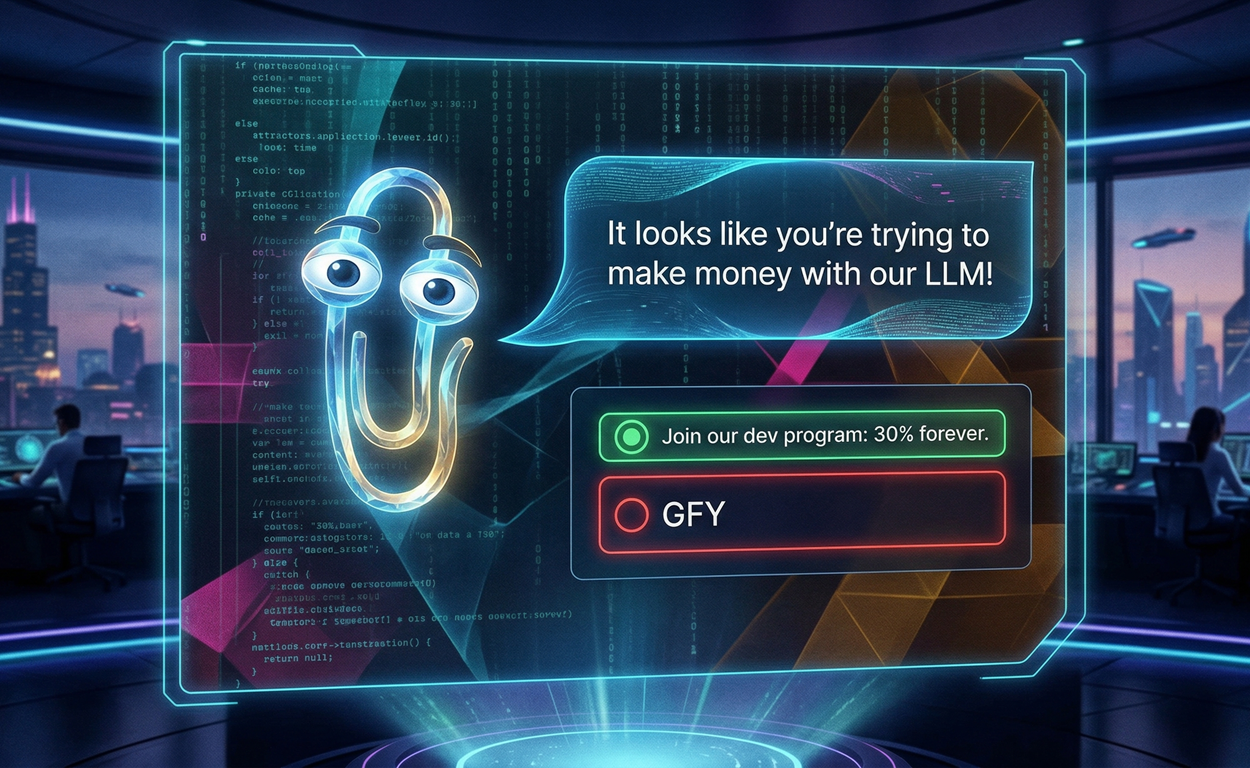
This outcome certainly is not ideal for the incumbents or for the frontier labs, and these are admittedly powerful, well-capitalized businesses. Absent extreme government regulation of all startups, however, I do not think they have a choice. If AI companies try to execute the Unity playbook, they will fail, because their technology is fundamentally a commodity. In the few years since Google’s famous “we have no moat” memo was written, the frontier labs continue to change places every few months. If some future CEO of Anthropic decides to charge royalties on any software coded by its models, just change the drop-down menu in Cursor to ChatGPT or Kimi and carry on.
Furthermore, the benefits of the frontier models are likely to decline relative to cheap options over time. Technology generally asymptotes, giving laggards opportunities to catch up. The best local and open-weight models of tomorrow are likely to be within striking distance of frontier models running in the cloud today. (The recent focus on harnesses (Claude Code, Codex, etc.) is transparently the latest attempt to combat this commoditization: if you can’t lock users into the models, try locking them into the harnesses instead.)
Incumbents could, theoretically, use AI to make their products better. Microsoft could integrate AI into Windows well instead of stupidly. Well, okay, that would be great! We would have more excellent software from which to choose. That would be a huge win for consumers and businesses.
They won’t of course. For thirty years, their business model has been built on exploiting captive users. Advertising and extractive corporate licensing is the business model of Windows; the 30% fee via a locked-down and crippled OS is how iOS makes Apple money.[3]
We are about to witness a titanic shift in computing. Until now, the only people who could experience the magic of watching a computer do what they wanted it to do were developers, and even then only with effort and in narrow contexts in which they possessed expertise and resources. The vast majority of us were forced into a very narrow range of choices, dictated mostly by oligopolies whose interests were (or became) at cross-purposes to ours.
This unfolding reality is why our investment thesis is tied so closely to AI-first startups. The picks-and-shovels phase of AI—the Nvidias, the hyperscalers, the foundation model companies—is where the money is today. But if I’m right that AI commoditizes both models and legacy software, then long-term value is going to migrate toward whoever builds the best agent infrastructure and the most compelling experiences on top of it.
For too long, tech has been about extracting value from users, leveraging the high hurdles of building complex software, and exploiting platform lock-in. That era is ending, and we intend to fund the people who are building the next one.


© 2026 Restive®, Inc.
