

Last year, I wrote a piece predicting a new period of development in the financial industry, "The Dawn of AiFi”, which outlined the massive potential of AI within the financial services market. Since then, we have made over a dozen new investments across every category we outlined in that paper, as well as a few more. We also have an additional year of growth in the market more broadly, and we have continued to evolve our thinking on how the AI Financial Services industry is developing.
One year on, we’ve seen a massive amount of value accrue to the financial services industry, both at the incumbents and at new startups. We’ve seen an explosion of growth in agentic commerce, rapid scaling of outcome-based business models, new approaches to managing AI-related risks, and exciting developments in data tools, new applications for enterprises, small businesses and consumers, and a Cambrian explosion of the agentic economy. It’s a thrilling time to be in technology and financial services, and a transformative period for the economy more broadly.
A New Gilded Age for Bankers and Investors
My thesis on AiFi was predicated on the idea that AI would power a new phase of global GDP growth, which in turn would drive significant growth in the financial services industry as new opportunities for lending, payments, asset management and risk intermediation increased.
So far, that prediction is spot on. US real GDP grew 2.1% in 2025. [1] This was above the CBO's pre-AI-boom projection of ~1.9% and AI clearly carried the economy last year: The St. Louis Fed estimates AI contributed roughly a percentage point of GDP growth through the first three quarters of 2025. This is a larger contribution than IT made at the peak of the dot-com era. [2] The downside for the real economy is that this growth appears to be mostly driven by financial activity rather than productivity gains. But if you’re in the right part of the financial services industry – debt financing, equity capital formation, and asset management – this growth is your real economy. This dynamic dovetails with the second leg of my AIFI thesis: that the incumbent financial institutions would significantly benefit from AI.
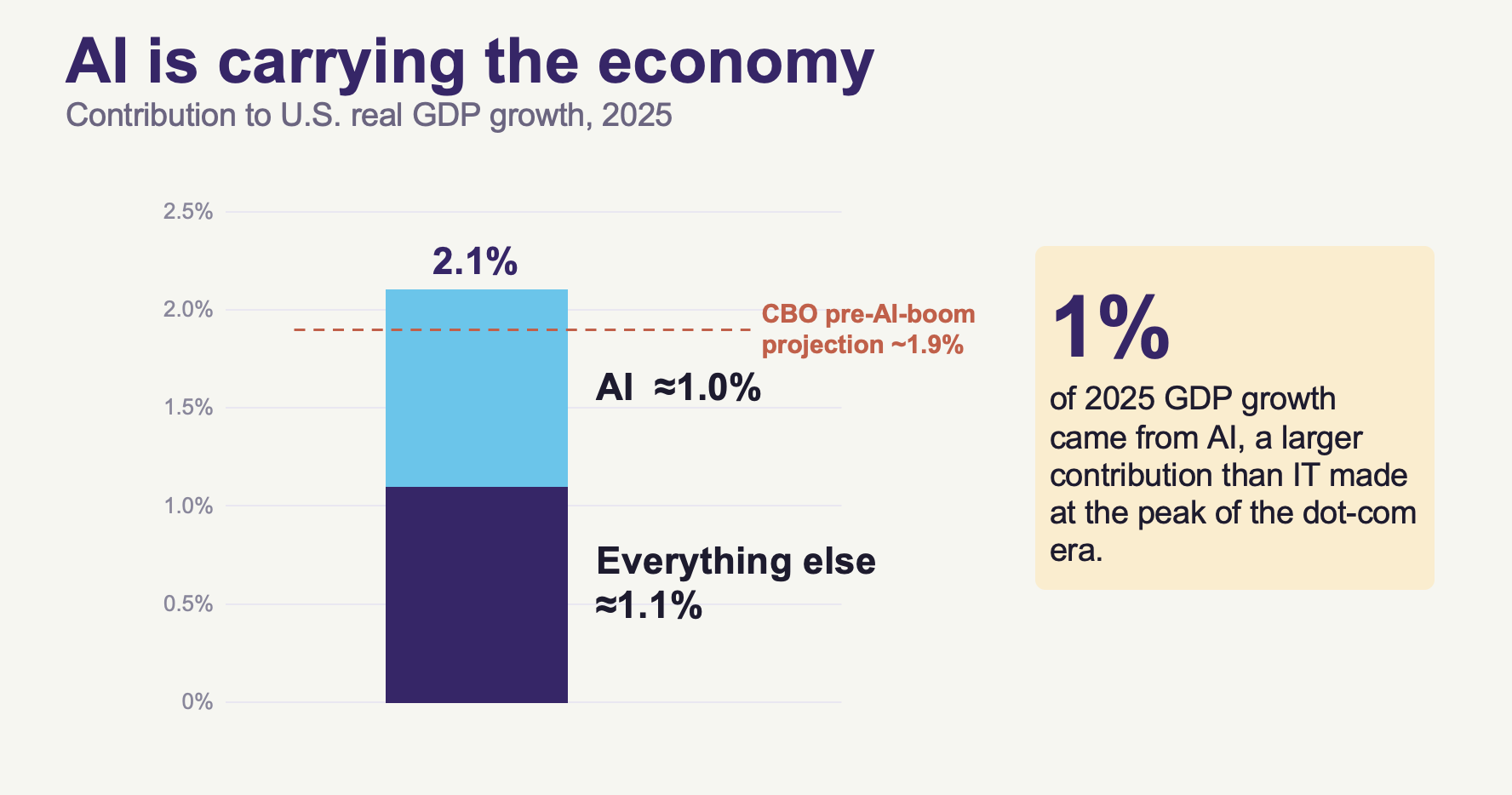
So far a huge chunk of the value created by AI is being captured by the financial services industry. Further, I argued that the benefits the incumbents gained in their core businesses from AI would be one of the reasons they would not divert significant resources into some of the more nascent parts of the industry - for example, instead of throwing their best minds into AI enabled lending, they should have them traditionally lend to the new data center businesses. Instead of focusing on agentic payments, they should expand their traditional payments businesses. Instead of leading venture firms focusing on catalyzing more entrepreneurs, they should allocate more capital to the biggest private firms. This part of the story has exceeded my expectations over the last year.
The massive growth in financing activities, asset management and equity markets has led to the fastest creation of value in some parts of the financial services industry, ever. Over the past year, Morgan Stanley and Goldman Sachs both delivered record revenue and profit numbers, mostly due to capital markets activity.[3] BlackRock crossed $14 trillion in AUM on record inflows. Private credit went from essentially zero AI-infrastructure exposure to more than $200 billion in AI-related lending, with over $800 billion more projected. Meanwhile the venture capital industry is predicting its largest year of LP distributions ever this year and next, as a wave of blockbuster IPOs comes to market, (of which the industry will capture 20-30% of the gains). The early years of AiFi are creating massive rewards to the firms that intermediate capital, such as banks, debt capital providers, asset managers, and of course, VC firms.
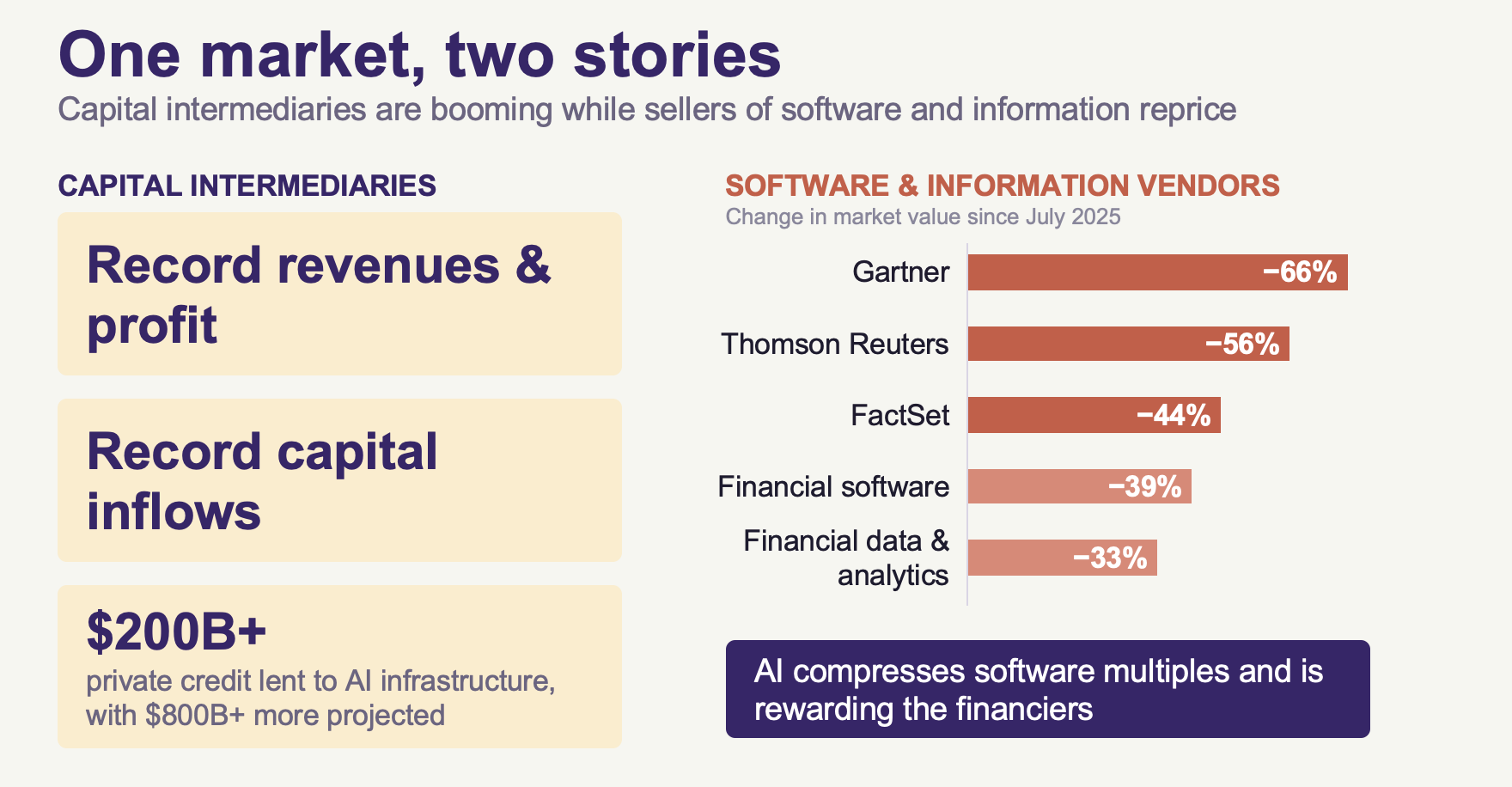
Notably, not all of the incumbents have been positively affected by this trend. There's been a significant distinction between those firms that were able to monetize and benefit from capital flows and asset gathering, versus those that have traditionally sold into the industry. The latter category included many of the traditional service providers to the financial services industry. To name a few examples, Gartner is down by 66%, Thomson Reuters is off by 56% and FactSet shed 44%. The numbers show that investors are expecting more competition in some formerly staid industries. In contrast to the intermediaries, the software and information layer of finance is seeing significant multiple compression as AI reduces the cost of software, weakens barriers to entry and creates new opportunities for startups. Financial software stocks are down ~39% and financial data & analytics down ~33% over the period. Even the private credit stress of the last year was largely around AI disrupting traditional software firms. [4]
The Opportunities
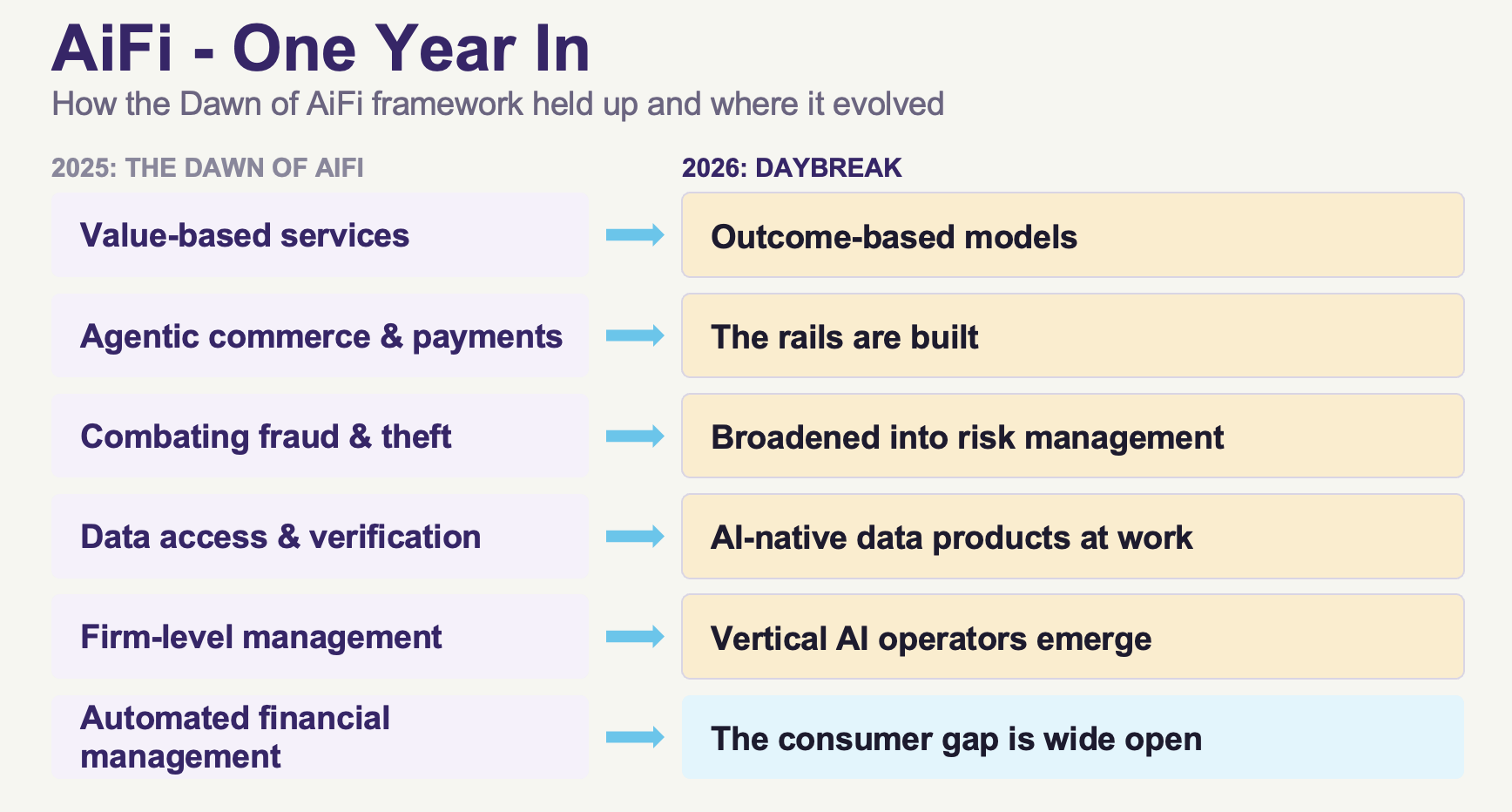
But as we pointed out in our post last year - and many times since then - we think the big winner in this market is going to be the startups. Last year, we identified six major areas where we could see new activity in AiFi: automated financial management, combatting fraud and theft, agentic payments, firm level management solutions, data, and value added services. We made new investments across each of these categories and saw an explosion of entrepreneurial activity outside of our portfolio. We also saw a number of moves from incumbents which validated a lot of our early thinking. If anything, we were too narrow in how we thought about the scale and scope of the market of AI Financial Services.
Value-added Services
Value-added services have exploded over the last year. One of the most visible trends in this category has been the rise of “outcome-based” business models.Their impact has been felt both within financial services and more broadly across the economy. Onshore, a Restive portfolio company, has seen explosive growth as companies of all sizes turn to them to take over complex – and expensive – tax and accounting tasks. Onshore nets a percentage of savings. Outside of financial services, Sierra and Decagon have found a fertile market in helping firms dramatically improve customer service. And in the legal market Legora and Harvey have also demonstrated the value of creating outputs at lower cost, faster.
The financial services industry still has lots of opportunity for these types of solutions, specifically around compliance, risk management, sales, and middle and back office tasks. What we've seen is necessary for startups to be successful in this category is a very high degree of industry expertise which allows founders to determine where tasks are mispriced, and where value can be both created for the customer and captured by the startup. In short, the product has to be so good that it turns a cost center into a profit driver.
Agentic Payments and Commerce
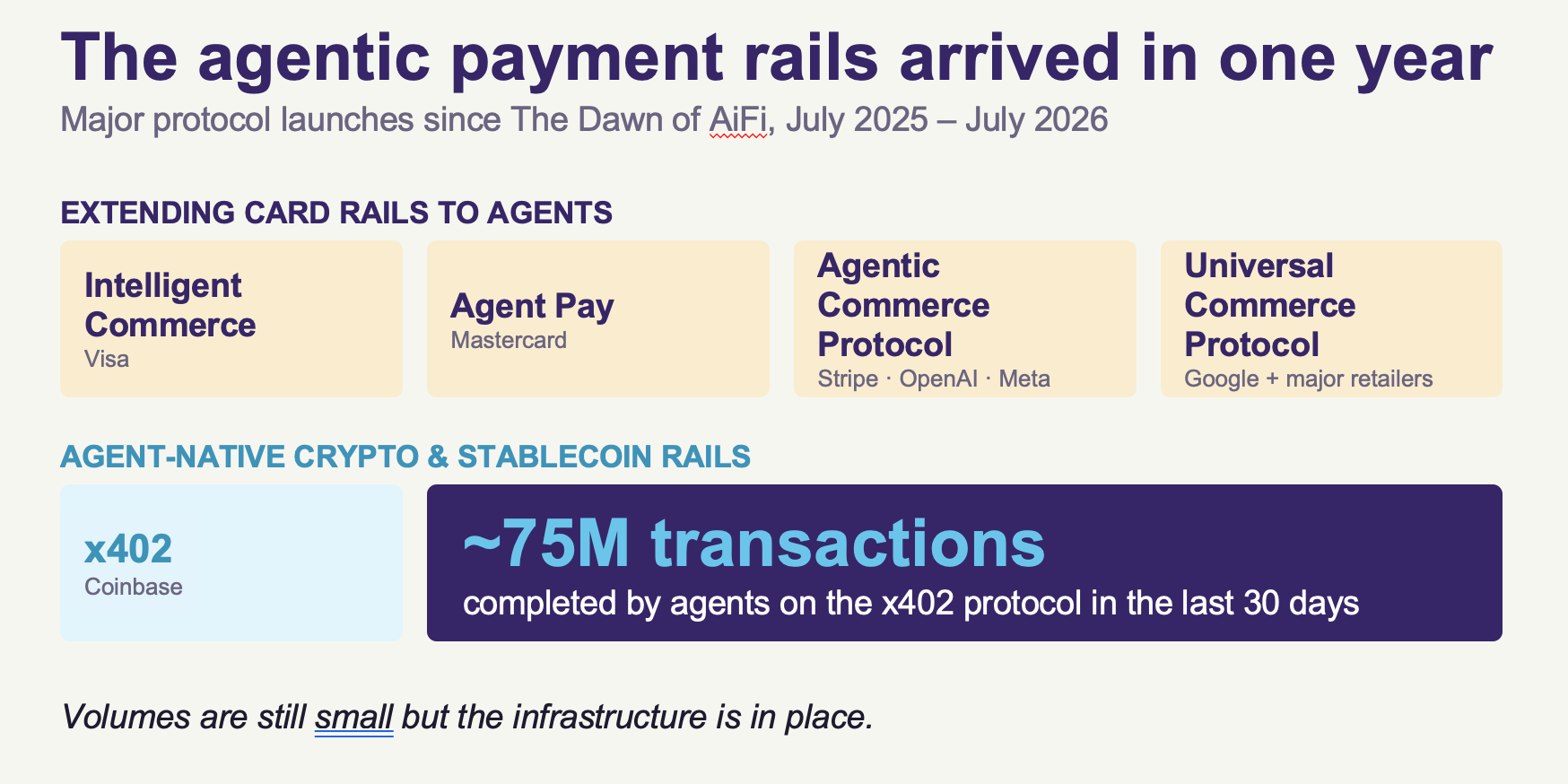
Agentic payments has been in the news over the last year with a number of new startups launching and lots of announcements from the incumbents as they seek to establish solutions that bring agents into existing payments ecosystems: Coinbase helped launched x402, Stripe, OpenAI and Meta launched Agentic Commerce Protocol, and a number of retailers have rolled out Universal Commerce Protocol (built with Google). Meanwhile, Visa launched Intelligent Commerce and Mastercard rolled out Agent Pay. While some of these initiatives are focused on extending card based payments to agents, we are starting to see economic transactions between agents that take advantage of crypto and stable coin rails as well: in the last 30 days, agents have completed nearly 75 million transactions on the x402 protocol.
We also see significant activity within the Restive portfolio. Manif is building developer tools to make it easy to integrate and accept agentic payments. Natural has built a agent-native payment ecosystem. Fragile is pioneering new approaches for product discovery and transaction execution. While the volume of payment activity remains relatively small, the infrastructure for much larger volumes is now in place. If there was one area in finance where the old adage around breakthrough technologies often looking like toys is true, it’s in agentic payments.
Considering this build out, we believe there is a massive opportunity on enterprise agentic payments: powering brands, purchasers and retailers to accept these payments. We also see opportunities in B2B payments more broadly: these routine - and often large - payments still rely on manual processes around checks, ACH and wires. In a space where there is no clear leader, where users are never satisfied with existing solutions, and the purchasers will pay for efficiency, we think that business agents and agentic payments will be transformative.
Risk Management (formerly known as Combatting Fraud and Theft)
When we sat down last year to think about the opportunity set in AiFi, we focused on fraud and theft largely as a logical extension of issues we’ve seen in traditional payments and banking. However, the dramatic advances in agentic productivity, the unrelenting growth of the LLMs themselves and the pace of AI adoption, including the growth of agents, has created far more risks and opportunities to address those risks beyond stopping fraud.
As a result, founders are building a variety of new strategies to manage risk more broadly. Those startups have addressed the risk through three major approaches: tools that use AI to bring more capability to the risk management function; products that allow firms to manage and offload AI-related risks, often through insurance or other risk and liability transfer mechanisms; and, tools to manage and mitigate AI-created risks, (i.e. risks that did not exist before AI).
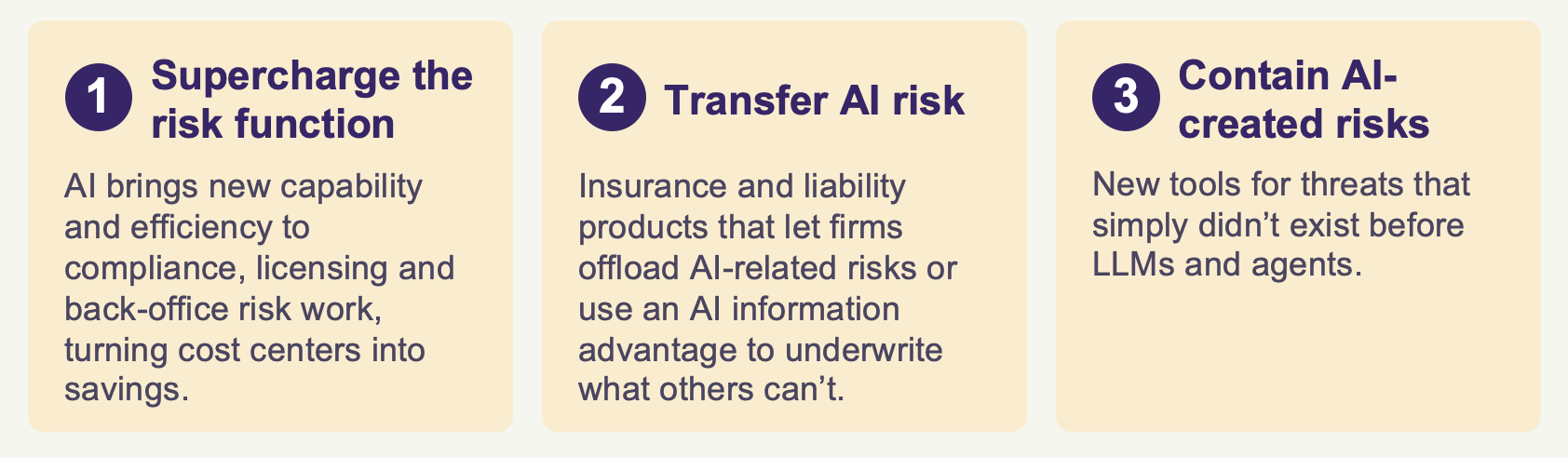
We remain excited about tools that use AI to bring more insight and efficiency to the risk management function, especially as we think there is significant opportunity to turn historic cost centers into revenue drivers or massive savings opportunities. Brico, a Restive portfolio company, is an example of how AI has allowed firms to offload licensing and compliance functions, which were time-intensive and costly, enabling firms to move faster. Larger firms like Vanta, Drata and Rippling also expand their offerings with AI tools to cover a larger surface area of risk challenges for their clients. Our view is that much of these back office functions will become the domain of AI in the coming years, with highly trained people on top, exercising judgement over only the most complex problems.
The second category is a relatively new one where startups allow their customers to offload AI-related risks through insurance or liability transfer, or are using AI to gain a previously unavailable information advantage to better understand risk than any conventional competitor. We’ve invested in a stealth company which will create insurance products targeted at protecting against AI specific risks.
We’ve also seen startups that seek to gain an underwriting advantage in traditional insurance verticals. Stand is an example of this. The company uses AI to better understand, measure and mitigate the risk of natural disasters in the property and casualty insurance market. Similarly, Coverwatch uses AI to expand the aperture of what is an insurable risk.
Finally, there are companies addressing risks that could simply not exist without agents and LLMs. Vectoral is a Restive portfolio company that addresses token fraud and theft, and offers a variety of anti-fraud tools for enterprises and AI firms to deploy. In periods of high growth, (which has defined 2025 and 2026), firms are willing to tolerate much more fraud and related losses as long as it’s accompanied by top-line growth. When the inevitable slowdown comes, we expect demand for these services to soar.
Data Accessibility, Verification, and Delivery
Most companies view their data as a source of competitive advantage. And there are large-scale opportunities to help firms use AI to access, protect and leverage that data. Within financial services, we’ve seen startups that bring fresh ideas and deep industry expertise create extraordinarily valuable products solving these data challenges. Rogo has taken an early lead in establishing itself as the capital markets industry’s most prominent AI-native solution, bringing insights to high value and highly dynamic functions like investment banking, trading and sales. Restive portfolio company FairPlay AI, which sits across the compliance function, helps firms understand how AI applications use their data and identifies and how the constant changes in the underlying models can affect their own decision making. Finny AI, another Restive portfolio company, leverages public and private data to help wealth managers identify new customers and better understand their existing customers, creating a more personalized client experience.
As agents proliferate with new use cases and data needs, we see a need for better infrastructure solutions, such as a Plaid-like product for agents to access financial data. Although Plaid pioneered access to consumer banking data a decade ago, the company is increasingly focused on serving banks and larger firms rather than the startups that propelled its early growth. The state of business data access is even more limited and tends to require locking into proprietary software or banking tools. We’re surprised we haven’t seen more direct competitors in such a fertile category – yet.
Firm-level Management Solutions
One of the great promises of AI is the concept of a copilot which can help individuals and businesses take more informed actions, more quickly and at lower cost. The vertical SaaS era of the 2010’s brought a panoply of point solutions, but it also created a morass of subscriptions, siloed data and integration challenges.
We believe the opportunity today is to create a purpose-built agent/AI stack for an entire industry. Within our portfolio, the most successful manifestations of this have been focused on small business owners. In our view, the optimal solution for the firm is a single solution that manages, hires, and fires the vertical software underneath it, or develops new software as needed, drawing on proprietary data. Once a company can unlock distribution across this industry, they become the defacto trusted AI partner for the owner.
Within our portfolio, Pie has started to serve this function for physical businesses that compete online and the country’s largest bankruptcy attorneys manage their business on Glade. These firms all share commonalities: they sell directly to the business leader. Their pitch is also simple: to help the firm make more money. While they may charge subscription fees like their SaaS counterparts, their revenue growth will come from increasing the financial performance of their customers, often with pay for success features that closely align incentives between the startup and the customer.
Consumer Solutions
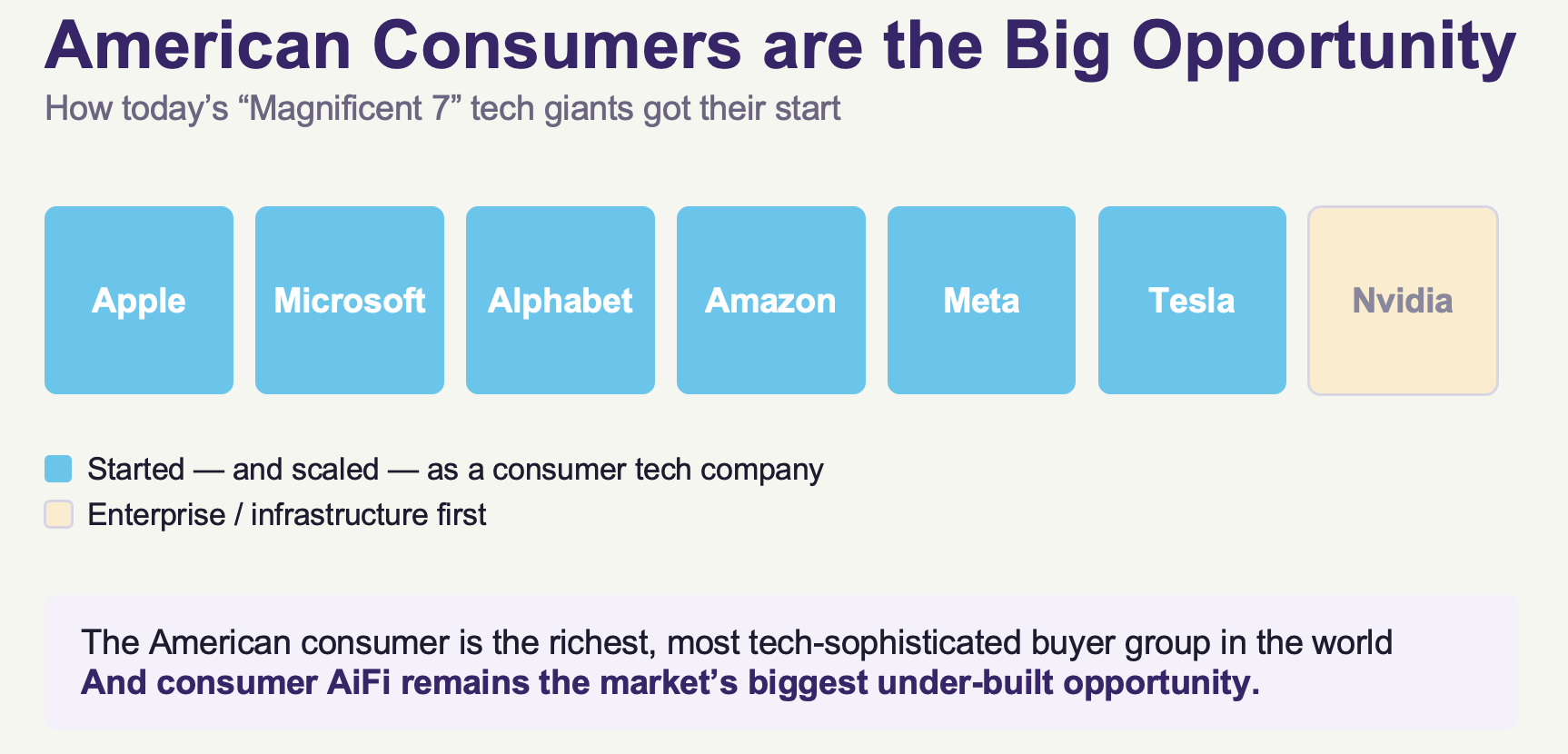
AI has the potential to automate consumers’ financial lives, helping them make better decisions, lower costs and, perhaps, make more money. Yet, despite this potential we have not seen nearly the volume or variety of solutions we would expect. We understand why founders are focusing on other parts of the AiFi ecosystem: there is still so much infrastructure to be built; the enterprise is a fertile market with a mandate to adopt AI solutions; and the model companies are improving so quickly that there is a concern that the foundation models will own all consumer tech. The last point is an oversimplification that deserves an entire paper on its own. And the first two points ignore a fundamental reality: the consumers have all the money.
It is worth noting that 6 of the 7 “Mag 7” started, and scaled, as consumer tech companies. The American consumer is the richest and most technologically sophisticated group of buyers the world has ever seen. These consumers also have lots of frustrations with the existing financial services industry, an industry that generally lacks creativity, taste and a willingness to experiment. Anyone who universally writes off consumer tech should do so at their peril.
Like many investors, we’re hoping that the next year brings us more creative consumer products that delight users, capture their attention and solve real problems. We think money is one of those problems that need to be solved and our commitment to investing in consumer tech has never been stronger. We are on the lookout for the next breakout consumer AI ‘fintech’ product so if you’re working in this space, please find us!
What’s next
The biggest trend we didn’t adequately scope last year was the rapid growth of agents, and the downstream challenges of deploying, securing and managing agents. This is something that cuts across each of these AiFi categories and which is still exceptionally early. We have also seen a number of new efforts towards building new models in financial services, with longer time horizons and deeper understanding of the actions and decisions associated with the industry. We expect this to be transformative, but to take time.
We’re still in the very early days of the AI revolution in financial services. If anything, our categories are proving to be too narrow and our estimates of the growth of the market too conservative. The last year was one of the busiest in our investing history at Restive and we expect next year to be even busier as we continue to see rapid company formation, more creative approaches, and faster execution. It’s an exciting time to build and invest. If you’re working in any of the areas above, or – especially – in a space that I missed, reach out. We want to be your partner to build the future of financial services.
[1] Bureau of Economic Analysis, 2025 GDP third estimate.
[2] Federal Reserve Bank of St. Louis, "Tracking AI's contribution to GDP growth"; see also J.P. Morgan Asset Management, "Is AI already driving US growth?".
[3] Wall Street Journal, “Goldman Sachs’s Profit Surges 78% to Quarterly Record”; Quartz, “Morgan Stanley posts record revenue and profit on a surge in stock trading”
[4] Morgan Stanley, FinTech Weekly Update, July 2, 2026 (sector multiples and returns; project files).


© 2026 Restive®, Inc.
